
Common Questions About Valentino Bags
The majority of enquiries about Valentino bags trace back to a short list of details that are strangely hard to find spelled out clearly. A lot of the material circulating online is flatly wrong, with authentication numbers and resale values where it goes wrong most often. One more source of muddle comes from a second company that shares part of the name. Each answer below is limited to what can be checked, with anything that is only market practice labelled as such. Prices are observed 2026 market prices on the brand’s own US site, not an official price list. Even if you came only for pricing, read the first four answers first, because they are the ones that head off the expensive mistakes.
Who founded Valentino, and does he still design?
The beginning belongs in Rome in 1960, on Via Condotti, where Valentino Garavani and Giancarlo Giammetti established the house. He sold the company in 1998, stepped away from design in 2007 with a final couture show in January 2008, and died on 19 January 2026 aged 93. The answer, then, is no: no recent bag was designed by him and he held no stake in the modern house. The house continues, with Alessandro Michele as creative valentino tote director since 2024, succeeding Pierpaolo Piccioli. Ownership lies with Mayhoola for Investments, which took 70 percent in 2012, and Kering, which took 30 percent in July 2023 and has stated an intention to acquire the company fully by 2028. Creative operations stay in Rome, while the legal registration is in Milan.
Are Valentino and Mario Valentino the same company?
No, and this is the most important thing to understand before buying. Valentino S.p.A., the couture house behind Valentino Garavani accessories, and Mario Valentino S.p.A. are two entirely separate businesses with no relationship between them. Mario Valentino goes back to Naples in 1952, still has its base there, and specialises in leather goods and footwear rather than couture. The label used is „Valentino by Mario Valentino“, and those bags are genuine, merely from a different company at a different price point. The company states that it has held the US trademark for handbags and leather goods since 26 April 1971, and legal reporting supports those senior rights. Litigation between them has been repeated, including a case filed in July 2019 that settled and was dismissed without prejudice on 14 June 2024, terms undisclosed.
What does GARAVANI on my bag mean?
Because a contract requires it. How each company uses the name is determined by a 1979 coexistence agreement, which obliges Valentino S.p.A. to use „GARAVANI“ alongside „VALENTINO“ on leather goods and in advertising for them. Under that same agreement Mario Valentino may use „Mario Valentino“, „M. Valentino“, „Valentino“, „MV“ or „V“ outside, on condition that „Mario Valentino“ appears inside and on packaging, while „V“ and „Valentino“ together are barred on leather goods. So the word on your bag is a legal obligation, not a branding flourish. Inside the house, accessories are labelled „Valentino Garavani“ while ready-to-wear carries „Valentino“ and „Maison Valentino“, and that is the same company and the same standards rather than a quality tier. If a bag reads only „Valentino“ and has „Mario Valentino“ inside, it belongs to the other company.
Is there a date code on a Valentino bag?
No, they do not. Valentino has no date-code system of the kind some other houses use, and this is a stubborn source of bad advice. What there is is a serial number, generally on a tag inside an interior pocket, with that tag often black, cream or light brown. That serial is not universal, since older models may carry none, and its absence alone is not proof of a fake. So a seller who offers to decode a date code is making it up as they go, and the claim should be read as a warning sign. Reportedly an authenticity card carries model spec, serial and Made in Italy, but the description comes from resale guides rather than the house, and many pre-owned bags arrive without one.
How do I spot a fake?
Settle which company made it before you ask whether it is real, because a genuine Mario Valentino bag will fail a Garavani checklist while being entirely authentic. Once that is settled, go through the physical details. The interior tag ought to read VALENTINO and GARAVANI in capitals with MADE IN ITALY, sewn on all four sides, the font weight consistent and the stamping unsmudged. Engraved rather than printed logos, square zip pulls with rounded edges and deep engraving, uniform pyramid studs that are evenly spaced and firmly set: that is what the hardware should show. Stitching should be even, aligned and consistent in density. Two claims can be ignored, that a date code proves anything and that a red lining proves authenticity, because neither is verified and provenance remains the real safeguard.
What do Valentino bags cost in 2026?
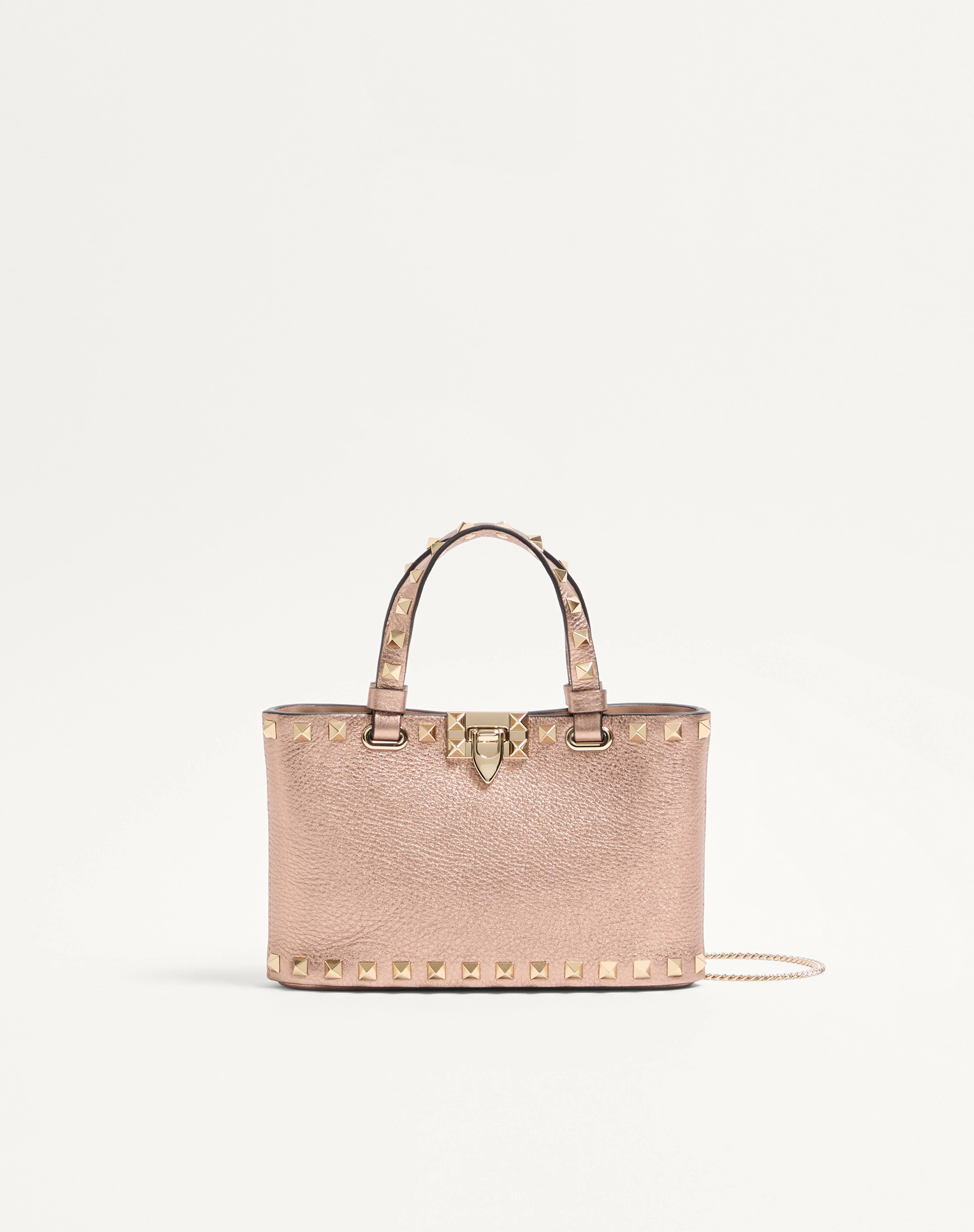
The observed range across current lines runs from $650 to about $7,900, and the spread inside one line is often wider than the gap between lines. Entry starts at roughly $650 to $1,500: VLogo Signature clutches, Rockstud wallets and the Rockstud mini shopping bag. The commercial core runs about $1,650 to $3,600 and contains most Rockstud, Rockstud Spike, Locò, VSling and VLogo shopping pieces. The top band, roughly $3,700 to $7,900, covers embroidery, crystal and pearl work and exotic skins. Material explains most of the variation, so the same Rockstud mini shopping bag is $1,390 in grainy calfskin and $1,850 in pony-effect. The table below shows the observed range for each major current line.
| Line | Range observed | Typical entry piece |
|---|---|---|
| VLogo Signature | $650 to $3,750 | Clutch in grainy calfskin, $650 |
| Rockstud | $1,250 to $2,100 | Mini shopping bag, $1,390 |
| DeVain | $2,100 to $3,900 | Shoulder in jacquard lurex, $2,100 |
| Rockstud Spike | $2,400 to $3,700 | Crossbody clutch, $2,400 |
| Locò | $2,700 to $5,900 | Calfskin small, $2,700 |
| VSling | $3,350 to $6,550 | Grainy calfskin small, $3,350 |
| Panthea | $3,800 to $7,900 | Nappa and suede chevron, $3,800 |
Do Valentino bags hold their value?
Moderately, and a good deal less than the eighty percent figure that circulates online, a number no verified data supports. Across the house, resale analysis puts Valentino handbags at roughly 41 percent retention. The strongest individual styles fall between 50 and 58 percent. The recorded examples include the Roman Stud Flap at 58 percent, the VLogo Locò Flap Shoulder at 57, the Rockstud Drawstring Bucket and Rockstud Flip Lock Flap at 56, and the Rockstud Pouch Crossbody at 50. In practice a medium Rockstud Spike has been observed near $1,700 against roughly $2,900 new. The recognisable motif bags hold best, leaving the house in mid-tier territory, and none of this is investment advice.
Where do I buy, and is there ever a genuine sale?
Buy from the house’s own webstore or boutiques, or from retailers verified as stocking the line: Neiman Marcus, Bergdorf Goodman, Saks Fifth Avenue, Nordstrom, Mytheresa, Net-a-Porter, Farfetch, Selfridges, Harrods, Giglio and Tessabit. A real Valentino bag sale does exist, because the house runs official seasonal sales on its own site, although as of September 2026 the US sale page said the Spring/Summer 2026 sale had ended. The page structure refers to private sales, which suggests a newsletter-gated mechanic rather than a permanently open discount store. THE OUTNET, the off-price arm of Net-a-Porter, does carry Valentino Garavani, although how deep its discounts run is not established. There is an outlet boutique at The Mall Firenze in Leccio Reggello, Tuscany, and a store is reported at Fidenza Village. Be sceptical of any site that stacks the brand name with words like outlet or sale and offers deep permanent discounts on current-season stock.
Are discount-chain Valentino bags the real thing?
They are genuine, just not what most shoppers think they are buying. Nordstrom Rack, Saks OFF 5TH and TJ Maxx stock „Valentino by Mario Valentino“, as their own brand-filter pages confirm. The maker is Mario Valentino S.p.A., the separate Naples company, not the couture house. So the bag is authentic and the retailer legitimate, and it is still not a Valentino Garavani bag. It will not carry GARAVANI on the interior tag, it sits at a different price point, and it will not behave like a Garavani piece on resale. Assume no US off-price chain is discounting genuine Garavani stock, and read the label before you read the price tag.
Which bag suits everyday use, and how do I care for it?
For everyday carrying, the most defensible choice is grainy calfskin in a recognisable silhouette: the Rockstud mini shopping bag at $1,390 if you want a Valentino tote bag, the small Rockstud crossbody at $1,650 if you want a Valentino crossbody bag, or the Rockstud small shoulder at $2,100 for a Valentino shoulder bag. Grainy calfskin keeps its shape, resists scuffing and hides fingerprints, and it is usually the least expensive material in its line. Care is general luxury-leather practice, not official instruction: wipe nappa and calfskin with a soft dry cloth, use a nappa cream, blot stains, and air dry rather than heat. A dry brush and a protector spray serve suede and kidskin, which should be kept away from water and oils. On laminated, metallic and mesh pieces the finish fails before the leather, and python and ostrich need professional care and no direct sun. Never polish plated antique-brass or light-gold hardware, and keep the bag in its dust bag, lightly stuffed, cool, dry and uncompressed.